Showing posts with label Iran. Show all posts

Tuesday, August 6, 2013

News Post August 6, 2012

!سلام
A lot happened in Iran over the past weekend, so I thought I'd share some headlines from a handful of Persian newspapers and websites.

The most prominent event, of course, was the inauguration of new president Hasan Rowhani.

BBC Farsi published an article with this headline:

روحانی: رويكرد اصلی دولت زمينه سازی برای مشاركت مردم است
Vocabulary:

رويكرد - approach
اصلی - main
دولت - government
زمينه - background
سازی - of
مشاركت - participation
مردم - people

***Translation:

The other significant occurrence, which received less attention in the Western media, was Rowhani's proposal of cabinet members. Tabnak described Rowhani's cabinet proposals with the following headline from this article:
 
 کابینه پیشنهادی کابینه 50-50 است 


Vocabulary:

کابینه - cabinet
پیشنهادی - proposed

Translation: The proposed cabinet is the 50-50 cabinet

The article describes Rowhani's proposed cabinet as an even split of conservatives/principalists and reformers. The move was seen as a bit disappointing by reformists with high hopes following Rowhani's election.


Tuesday, July 9, 2013

Ahmadinejad Interview


One more thing I'd like to post today in addition to the song Ye Dokhtar and it's lyrics. Last week, former Iranian President Mahmoud Ahmadinejad gave an interview in Iran where he reflected on his time in office. Soheil found a section that he thought encapsulated the interview, not to mention Ahmadinejad's attitude, very well.

رئیس‌ جمهور یادآور شد: ما تنها دولتی هستیم که به راحتی در تمام اجتماعات مردم وارد می‌شویم و این کار را بدون هیچ دغدغه‌ای انجام می‌دهیم. من خیلی راحت وسط مردم می‌روم ‌و مثل ماهی که وارد اقیانوس می‌شود، کیف می‌کنم. همه را دوست داریم و نمی‌توانیم دوست نداشته باشیم و من فکر می‌کنم ‌این فرهنگ دوباره در کشور ما احیا شده است. این فرهنگ در میان ما ایرانیان وجود داشته و خانواده‌ها در میان خود مسائل را حل می‌کردند و نمی‌گذاشتند کسی زمین بخورد اما در حال حاضر فاصله افتاده و باید این موضوع به صورت کامل احیا شود


Basic Translation:

The president noted: We are the only government that easily enters entire communities of people, and we do this work without any concern. I am very comfortable going in the middle of people (amongst the people), and like a fish entering the ocean this pleases me. We love all, and we are unable not to love (double negatives are allowed in Persian), and I think this culture has been resurrected/restored again in our country. This culture has existed between we Iranians, and families solved issues among themselves, and they didn't allow people to fall, but distance has fallen (between families) in present times and we should restore this issue to full form.


After reading this interview, I was reminded of a Persian word Soheil taught me: پر رو
The transliteration of this word is por roo. Por means full, and roo refers to the Persian word for face. It essentially means full of oneself, cocky, arrogant, etc. I'm sure after reading that excerpt you can understand why the word came to mind!


Sunday, June 16, 2013

News Post June 16, 2013 (Rouhani's Victory)

Yesterday Iran's interior ministry announced that reformist minded cleric Rouhani won the Iranian presidency with 50.7 percent of the popular vote (law stipulaes that if one candidate doesn't eceive 50% the two top candidates must participate in a run-off).

I honestly was extremely surprised! I had kind of expected that a run off would be forced and that a conservative candidate would ultimately succeed.

It will be interesting to see what, if any, changes occur in Iranian foreign policy now.

Monday, June 10, 2013

News Post June 10, 2013

The Last Iranian Presidential Debate

The last debate before Iran's presidential election was held this past Friday, and the event was certainly more spirited than the previous two sessions.

The part I'd like to focus on is the sharp exchange that occurred between Rouhani (a reformist and cleric) and Ghalibaf (current mayor of Tehran and a conservative). It can be seen in this video: http://www.youtube.com/watch?v=IoJJnAi_hzw

After Rouhani made a comment about providing peace for Iranians, Ghalibaf criticized him for his handling of student protests in 2003 when Rouhani was Secretary of the National Security Council. This kicked off an exchange where the two candidates traded remarks about their own versions of how the situation was handled (Ghalibaf was the head of police at the time).

In the clip, Ghalibaf says Rouhani denied granting the students in question permission to protest in 2003. Rouhani counters by saying he was concerned that if the he granted them permission and they left campus, the police under Ghalibaf would arrest all of them. Rouhani goes on to say that he wasn't concerned about the students because he felt they would dissipate in a few days time.

The exchange continued in this manner, with the candidates giving conflicting accounts of events, neither of which can really be verified. Hopefully the high energy of this debate will help capture Iranian interest, which had been low, in the elections which are now just 4 days away.    


Conditional Sentences in Persian

Hello All!

The lesson I'm uploading today provides an overview of the structural formats conditional sentences can take in Persian. Understanding these rules will allow students studying Persian to make more complex sentences as they practice.


Tuesday, June 4, 2013

News Post June 3, 2013

The first Iranian Presidential debate occurred three days ago and featured all eight candidates. The debate was not without controversy, though, as several of the participants called the format into question. The following articles discuss the debate and the aforementioned controversy.

The first article comes from the BBC's Persian language site, www.bbc.co.uk/persian.


Article Points:
  • The author starts by pointing out that Tehran is often called the world's (دنیا) cosmetic surgery capital (پایتخت جراحی زیبایی). He then uses cosmetic surgery as a metaphor for the issues the candidates are discussing. The author feels they're superficial and don't address the real challenges facing Iran.
 
The second article comes from ghanoondaily.ir.


The title translates: IQ Test (تست هوش) in First (نخستین) Debate (مناضره) 

The subtitle in red translates loosely as: The candidates (نامزدها) prescription (نسخه) for healing(شفابخشي) the country's (کسور) economy (اقتصاد) was not given (تجويز نكردن)


The full article in Ghanoon is much longer, but it essentially describes part of the debate's format which was structured as multiple choice questions. Candidates were prompted with a question by the debate moderator, and asked to respond with one of three answers (hence the tongue and cheek title 'IQ Test.' Several of the candidates called the format childish and refused to participate. 

Some journalists have speculated that the debate was structured in such a way to avoid any explosive confrontations, like the one that broke out between President Ahmadinejad and challenger Mousavi in 2009.   

As a little background, here is a link to the debate between Ahmadinejad and Mousavi. Ahmadinejad, who was facing criticism following the discovery that one of his political appointees had lied about his possession of a doctoral degree, presented a file on Mousavi's wife. Ahmadinejad then claimed Mousavi's wife had falsely obtained her advanced degrees and then illegally secured a position as president of an Iranian university. http://www.youtube.com/watch?v=Luvx4gwgdSg

Also, here is a link to a collection of scenes from the last debate when things were breaking down and some candidates refused to answer questions:
http://www.youtube.com/watch?v=SNOVvIbbuBU

Wednesday, May 29, 2013

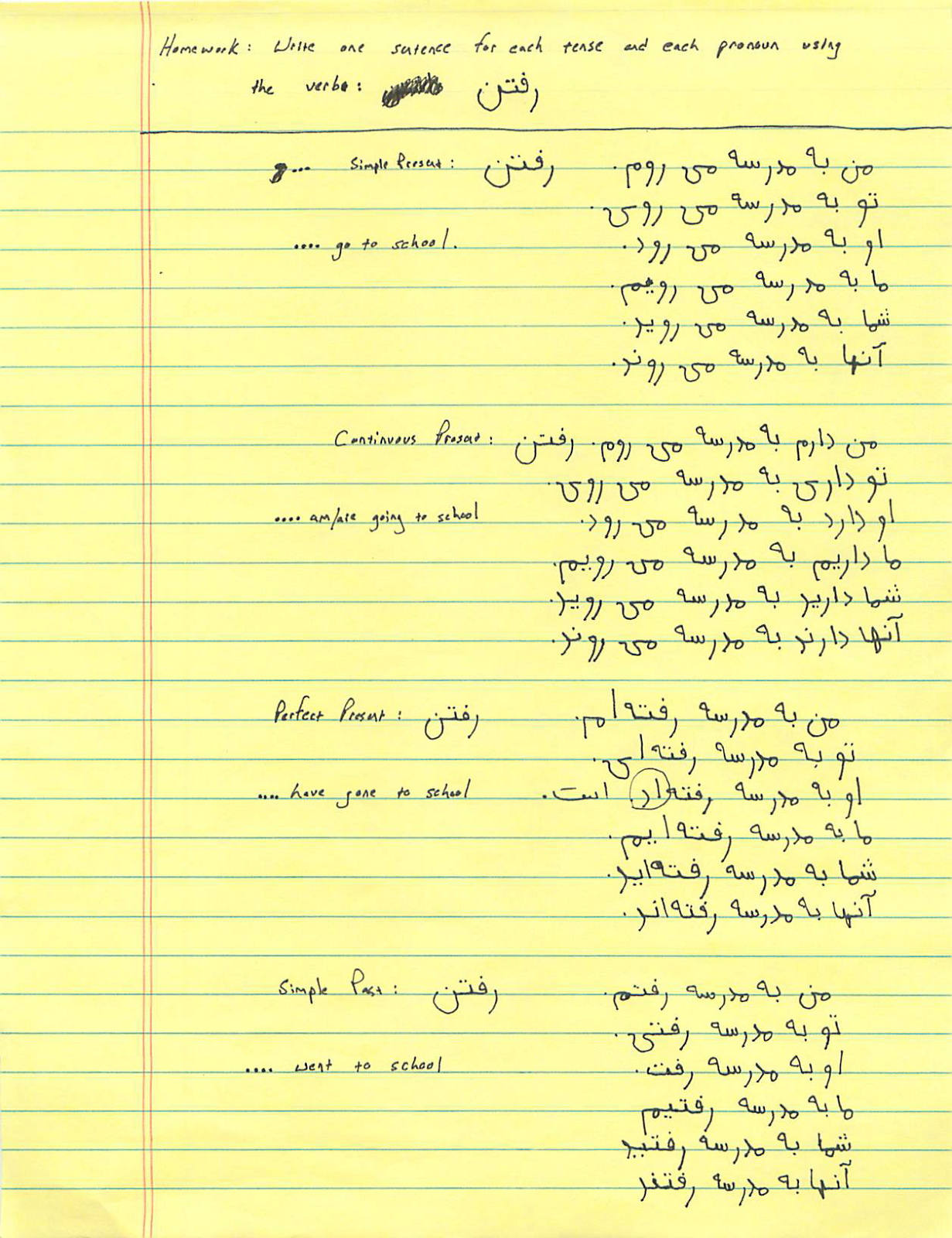
Seven Persian Verb Tenses

I completed the lesson I'm posting today to serve as a reference for the rules associated with different verb tenses in Persian. Included are the; simple present, continuous present, perfect present, simple past, continuous past, perfect past, and future tenses. This was a big help to me as a moved on to writing more complex Farsi sentences, so I hope you find it useful.


Friday, May 24, 2013

News Post: May 24, 2013

The dominating story in Iran this week has been the announcement of the final presidential candidates approved by the Guardian Council. Nearly seven hundred would be candidates registered, but after the Council (who is responsible for vetting candidates) completed their review, eight presidential hopefuls remained.

Also, I thought it would be helpful if I started highlighting and underlining some vocabulary key to understanding the article. I'll provide the vocabulary after articles.

 
8 کاندیدای انتخابات ریاست جمهوری از فیلتر شورای نگهبان عبور کردند
  ۸ نفر از ثبت نام کنندگان انتخابات ریاست جمهوری از فیلتر شورای نگهبان عبور کرده‌اند و تا ساعاتی دیگر اسامی آنها توسط وزارت کشور اعلام می‌شود.

در میان اسامی ارسالی به وزارت کشور نام اسفندیار رحیم مشایی و اکبر هاشمی رفسنجانی وجود ندارد.

حداد عادل، محمد باقر قالیباف محسن رضایی، علی اکبر ولایتی، سعید جلیلی، محمد غرضی، حسن روحانی و محمدرضا عارف صلاحیت‌شان احراز شده است
 
8 کاندیدای انتخابات ریاست جمهوری از فیلتر شورای نگهبان عبور کردند
 
The article above comes from the website khedmat.ir, which is closely associated with current Iranian President Mahmoud Ahmadinejad.
 
Title Translation:
Eight candidates for the presidency passed the filter (vetting/review) of the Guardian Council
 
Article Summary:
 
Line One: Eight presidential registrants have been approved by the Guardian Council and will be announced in a few hourse by the Interior Ministry.
Line Two: Names not announced as approved to run (and very notably absent) are Esfandiar Rahim Mashaei (Ahmadinejad's former chief of staff and the candidate he has strongly backed) and Akbar Hashemi Rafsanjani (former Iranian president, reform candidate, and very prominent Iranian politician).
Line Three: The eight, approved presidential candidates are; Haddad Adel, Mohammad Bagher Ghaleebaf, Mohsen Rezaee, Ali Akbar Velayati, Mohammad Gharazy**, Hassan Roohani, and Mohammad Reza Aref . 
 
Key Vocab:
 
(candidate) کاندیدا
(election) انتخابات
(president) ریاست جمهوری
(council) شورا
(guardian council) شورای نگهبان 
(to cross, in this case 'they crossed' means they were approved) عبور کردن 
 
The news that Mashaei and Rafsanjani would not be allowed to run made major headlines in Iran and provoked strong reactions from the camps of both candidates, who are both holding out hope that they will be re-instated and allowed to run. I will follow this post with an article from each of the blocked candidates' camps that describes their reactions.


Thursday, May 23, 2013

Blog Introduction

After receiving some feedback following my first post, I realize I probably should have kicked this thing off with some information about myself and why I created this blog. So here it goes:

My name is Jordan and I started graduate school in January 2013 after a five year stint in consulting. I really enjoyed the challenges consulting presented; working in a variety of industries, solving unique problems, and designing business solutions. However, my passions have always been international affairs and language, so here I am back in school.

A couple of years before I started grad school, I hired a private tutor at a language school and began studying Persian/Farsi (I'll use those interchangeably on this site). My tutor was a native speaker who taught me the Persian alphabet, vocab, and how to write sentences in the simple present, simple past, and future tenses. My tutoring and Persian studies, though, were cut short when I was offered a consulting assignment in the Netherlands for a year.

When I returned home, I was pretty out of practice as far as Persian goes. I made an appointment with the Persian professor at the university where I planned to enroll, and she recommended that I take some lessons as a refresher prior to joining the Spring Persian 2 class. I was referred to a doctoral student at my university, Soheil, who is a Farsi native speaker.

I've been taking lessons with Soheil since that time (November 2012), first as a refresher and then to compliment the coursework of my Persian class. The idea for this blog came out of one of our Farsi lessons. I told Soheil I wanted a better way to keep track of and share the language work we do. He thought a valuable next step in my Persian studies would be reading and interpreting articles from Persian language newspapers and magazines. The end result is this blog.

Postings will either be related to grammar and vocab lessons we've completed, or stories that would otherwise be inaccessible to non-Persian speakers. My hope is that sharing some of these news stories will help broaden the understanding of Iran for anyone who happens to read this blog. As I've gradually discovered, there is far more to the internal politics of Iran than the same two or three news lines that are picked up and dissected by international media.

Enjoy!   

Tuesday, May 21, 2013

News Post: May 20 2013

My first news post includes two articles and comes from the Iranian news website Tabnak (tabnak.ir). Tabnak has the highest traffic of any news site in Iran and is generally considered a credible source. The site is associated with Mohsen Rezaee, the founder of the Revolutionary Guards and current head of Iran's Expediency Discernment Council. That being the case, Tabnak could be classified as more conservative and close to the Iranian government.


A basic translation of this article's title is: Larkani withdraws his candidacy for the benefit of Jalili
This article goes on to describe how Larkani decided to end his candidacy in support of Presidential hopeful Saeed Jalili. Both men are very conservative and favored by Iranian leadership. Saeed Jalili is particularly notable for his position leading negotiations related to Iran's nuclear program. Support from other conservative candidates like Larkani, in conjunction with his favorable standing and notoriety, could make Jalili an extremely interesting candidate to watch in the coming weeks.


This article is a bit of a departure from the Iranian presidential race. The title mentions some comments made by the Iranian Minister of Communications regarding the earth's atmosphere. If you think, based on that, that the body of the article will describe the Minister's concerns about pollution or the climate, you're slightly off. The Minister states that an important discovery has been made regarding one layer of the earth's atmosphere. It has been determined, he claims, that pictures and sound can travel better through this particular layer of atmosphere. Most importantly, he goes on to assure that when the hidden Imam of Shia Islam reveals himself, he will be able to broadcast his message to the entire world using this atmospheric layer... The article's author not only calls the Minister out on the stupidity of his statements, but criticizes him for tying important religious figures to wild claims easily proven incorrect.