Showing posts with label Persian Lessons. Show all posts

Monday, July 22, 2013

Star Spangled Banner in Farsi

!سلام بچه ها


Recently, I've been listening to some Iranian songs to get more accustomed to hearing quickly spoken Persian. I've also been translating some of the lyrics and uploading them here. As an exercise in translating English to Persian, we thought it'd be cool to translate America's national anthem, the Star Spangled Banner.

The translation isn't exact because of the nature of the language used in the anthem, but it's pretty close:

بگو آیا می توانی با نور سحر ببینی
ما چه با غُروُر خواندیم در نور آخر گُرگ و میش؟
 
نَوارهای پهن و ستاره های روشن چه چیزی را
از میان جنگ خطرناک روی دیوار تماشا کردیم
که داشتند با افتخار پرواز می کردند؟
 
و نور قرمز موشک ها انفجار بمب ها در هوا
از میان شب اثبات کرد که پرچممان هنوز آنجا بود

بگو آیا آن پرچم پر ستاره هنوز پرواز می کند
بر فراز کشور آزادی و خانه شُجاعان؟

Useful Vocabulary:

 غُروُر - Pride
نور - Light
گُرگ و میش - Twilight (This literally means Wolf and Sheep. It's a very Persian way of saying a mixing of dark and light)
نَوار - Stripe
پهن - Broad  
ستاره - Stars
روشن - Bright 
از میان - Through, amongst 
جنگ - Fight, war 
خطرناک - Dangerous, perilous
افتخار - Honor
موشک - Missile
انفجار - Explosion, burst
بمب - Bomb
اثبات - Proof
پرچم - Flag
آزادی - Freedom
شُجاعان - Braves

Tuesday, July 16, 2013

Persian Comparative

Using the comparative in Persian is really quite simple! The notes in this post outline how to form comparative sentences, and also provide a few additional vocab words. I apologize if some of the light ink is hard to read!


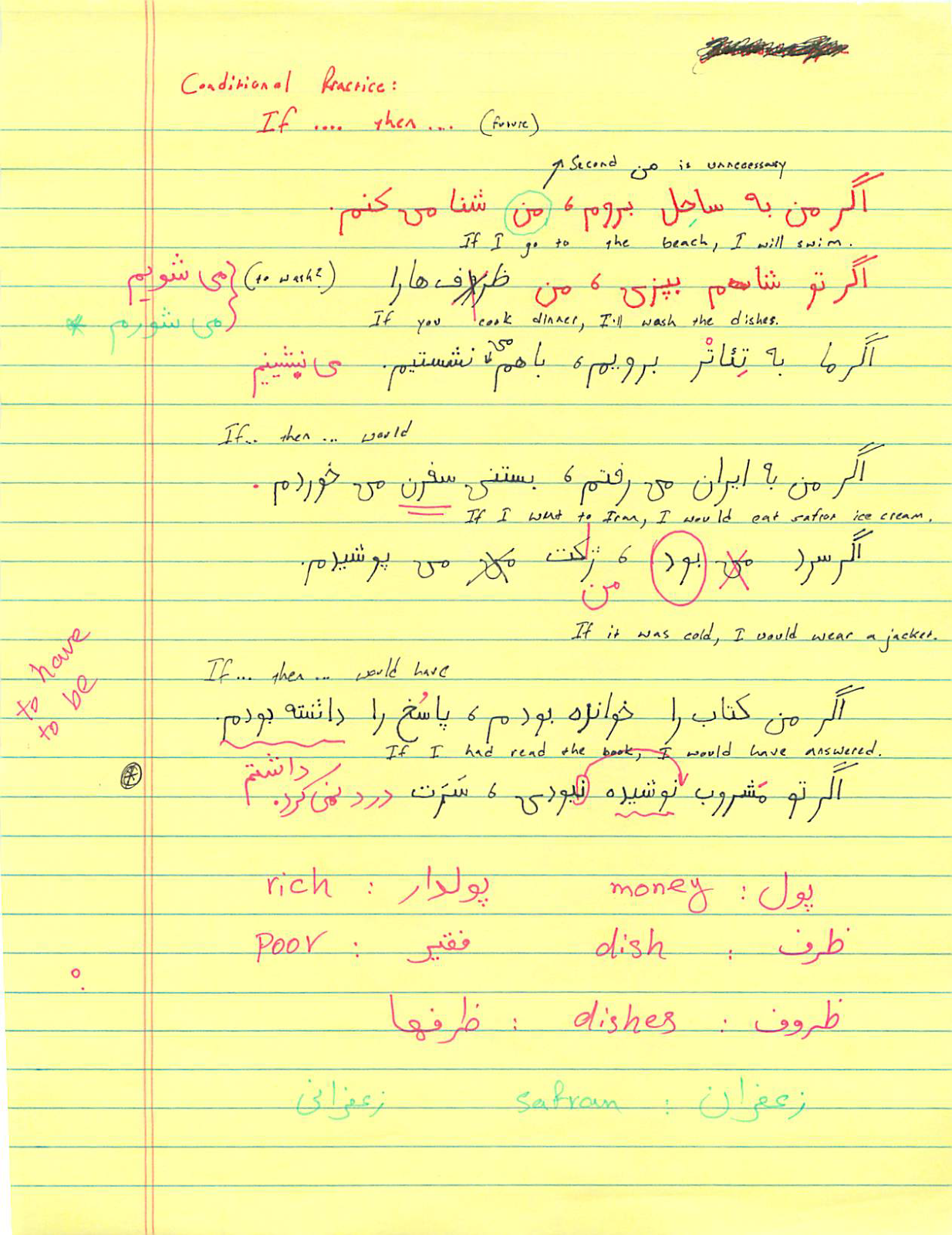
Conditional Sentence Practice

A month ago I uploaded some notes that provide a high level overview of the rules and structures for conditional sentences in Persian. Here are some additional examples I wrote for practice.


Tuesday, July 9, 2013

Ahmadinejad Interview


One more thing I'd like to post today in addition to the song Ye Dokhtar and it's lyrics. Last week, former Iranian President Mahmoud Ahmadinejad gave an interview in Iran where he reflected on his time in office. Soheil found a section that he thought encapsulated the interview, not to mention Ahmadinejad's attitude, very well.

رئیس‌ جمهور یادآور شد: ما تنها دولتی هستیم که به راحتی در تمام اجتماعات مردم وارد می‌شویم و این کار را بدون هیچ دغدغه‌ای انجام می‌دهیم. من خیلی راحت وسط مردم می‌روم ‌و مثل ماهی که وارد اقیانوس می‌شود، کیف می‌کنم. همه را دوست داریم و نمی‌توانیم دوست نداشته باشیم و من فکر می‌کنم ‌این فرهنگ دوباره در کشور ما احیا شده است. این فرهنگ در میان ما ایرانیان وجود داشته و خانواده‌ها در میان خود مسائل را حل می‌کردند و نمی‌گذاشتند کسی زمین بخورد اما در حال حاضر فاصله افتاده و باید این موضوع به صورت کامل احیا شود


Basic Translation:

The president noted: We are the only government that easily enters entire communities of people, and we do this work without any concern. I am very comfortable going in the middle of people (amongst the people), and like a fish entering the ocean this pleases me. We love all, and we are unable not to love (double negatives are allowed in Persian), and I think this culture has been resurrected/restored again in our country. This culture has existed between we Iranians, and families solved issues among themselves, and they didn't allow people to fall, but distance has fallen (between families) in present times and we should restore this issue to full form.


After reading this interview, I was reminded of a Persian word Soheil taught me: پر رو
The transliteration of this word is por roo. Por means full, and roo refers to the Persian word for face. It essentially means full of oneself, cocky, arrogant, etc. I'm sure after reading that excerpt you can understand why the word came to mind!


Monday, June 24, 2013

The Subjunctive in Persian

Hi All!

I apologize for my absence over the last week. Today I'm uploading some notes on the use of the subjunctive in Persian. The subjunctive is used to make sentences with auxiliary verbs like 'want,' 'should,' 'can,' and 'must,' etc. As always, learning these rules will allow you to make increasingly complex and expressive sentences in Persian!


Monday, June 10, 2013

Conditional Sentences in Persian

Hello All!

The lesson I'm uploading today provides an overview of the structural formats conditional sentences can take in Persian. Understanding these rules will allow students studying Persian to make more complex sentences as they practice.


Wednesday, May 29, 2013

Seven Persian Verb Tenses

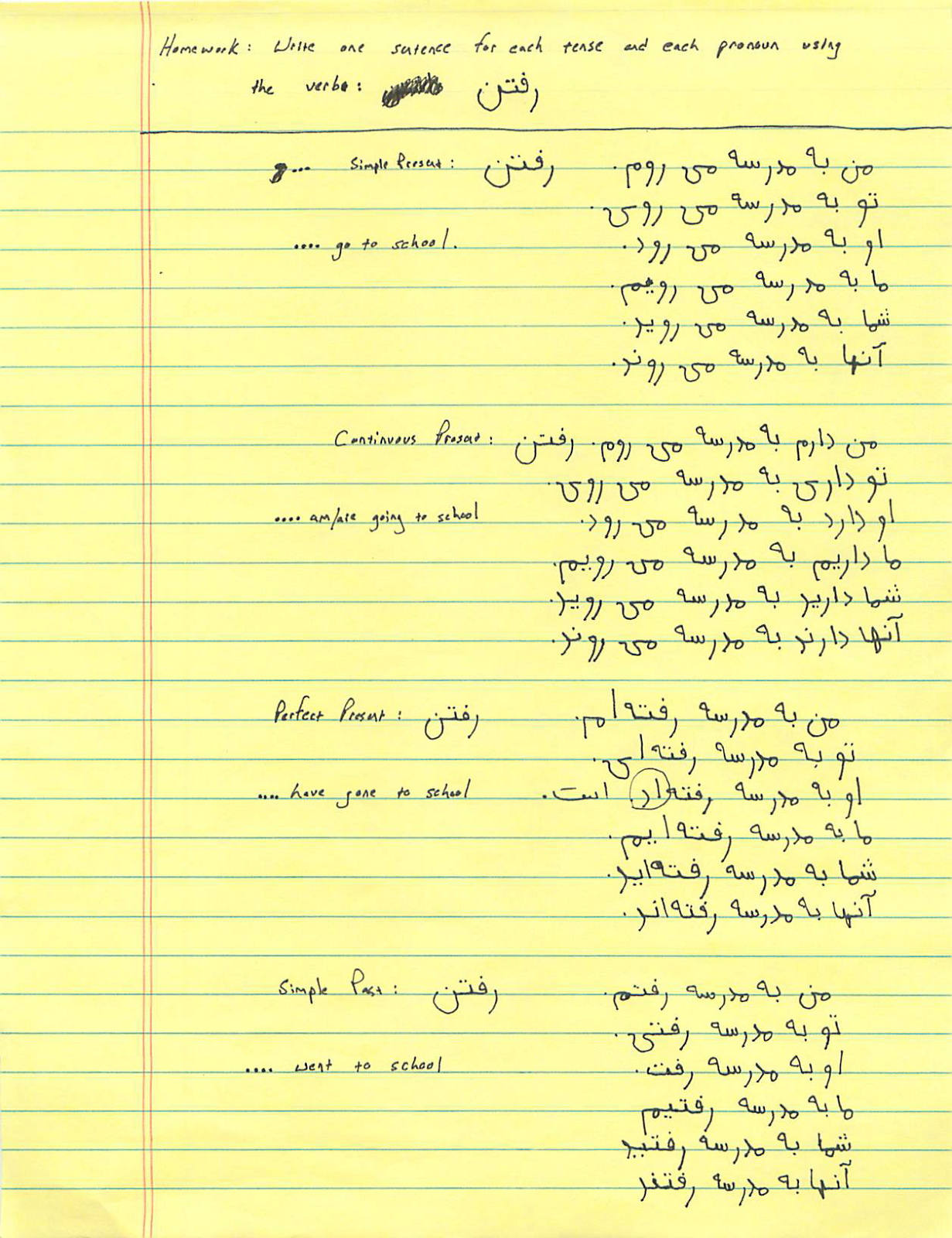
I completed the lesson I'm posting today to serve as a reference for the rules associated with different verb tenses in Persian. Included are the; simple present, continuous present, perfect present, simple past, continuous past, perfect past, and future tenses. This was a big help to me as a moved on to writing more complex Farsi sentences, so I hope you find it useful.


Tuesday, May 28, 2013

Persian Sentences with Multiple Adjectives

The Persian language notes/homework I'm uploading today expand on the previously mentioned fact that in Persian, adjectives follow the nouns they describe. Enjoy!


Soheil's corrections are in colored pen. I hope these examples prove useful!

Thursday, May 23, 2013

Some High Level Persian Grammar Notes

Before I start posting any Persian grammar or vocab work I've done, I should mention that this site isn't intended to teach Persian from the ground up. As a  current Farsi student, I think I'd be getting well ahead of myself if I started trying to teach anyone else the language. I do, however, wish to share the work that I do in the hopes that it might benefit others who are learning Persian. You'll be able to see my mistakes, see groupings of new vocab, and see compilations of grammatical tenses. For any native Persian speakers who happen upon this blog, I'm sure you'll be able to get a laugh out of some of my practice and homework sentences (some weeks I'm better than others).

Anyone who's interested in learning some Persian online should definitely check out the site http://www.easypersian.com. It starts with the Persian alphabet and then provides a ton of information.

Having said all of that, here are some high level notes on the first topics I reviewed with my tutor Soheil. This will give you an idea of where I stood when I returned to Farsi lessons in November of 2012.

In our first few lessons, Soheil reviewed some foundational characteristics of Farsi. Like when to use 'را' after direct objects (I think this is universally challenging for many native English speakers learning Persian), and the all important fact that in Persian, unlike in English, nouns come before the adjectives that describe them.

In English, we would say "the fast, red car." In Persian, the order would be "car red fast." 
 

Blog Introduction

After receiving some feedback following my first post, I realize I probably should have kicked this thing off with some information about myself and why I created this blog. So here it goes:

My name is Jordan and I started graduate school in January 2013 after a five year stint in consulting. I really enjoyed the challenges consulting presented; working in a variety of industries, solving unique problems, and designing business solutions. However, my passions have always been international affairs and language, so here I am back in school.

A couple of years before I started grad school, I hired a private tutor at a language school and began studying Persian/Farsi (I'll use those interchangeably on this site). My tutor was a native speaker who taught me the Persian alphabet, vocab, and how to write sentences in the simple present, simple past, and future tenses. My tutoring and Persian studies, though, were cut short when I was offered a consulting assignment in the Netherlands for a year.

When I returned home, I was pretty out of practice as far as Persian goes. I made an appointment with the Persian professor at the university where I planned to enroll, and she recommended that I take some lessons as a refresher prior to joining the Spring Persian 2 class. I was referred to a doctoral student at my university, Soheil, who is a Farsi native speaker.

I've been taking lessons with Soheil since that time (November 2012), first as a refresher and then to compliment the coursework of my Persian class. The idea for this blog came out of one of our Farsi lessons. I told Soheil I wanted a better way to keep track of and share the language work we do. He thought a valuable next step in my Persian studies would be reading and interpreting articles from Persian language newspapers and magazines. The end result is this blog.

Postings will either be related to grammar and vocab lessons we've completed, or stories that would otherwise be inaccessible to non-Persian speakers. My hope is that sharing some of these news stories will help broaden the understanding of Iran for anyone who happens to read this blog. As I've gradually discovered, there is far more to the internal politics of Iran than the same two or three news lines that are picked up and dissected by international media.

Enjoy!